
What should we really think of the wheeled broadfork with clod breaker? Here is a closer look at how a counter-tine crumbler works, along with its real impact on soil structure and weed growth.
The broadfork has come a long way since it was invented by André Grelin in 1963. After the classic models designed to aerate and loosen soil without turning it over, the broadfork with clod breaker emerged to make crumbling heavy soil easier too.
From the first pivoting broadforks equipped with counter-tines to later wheeled models, let’s trace the major milestones of this market gardening tool, starting in Russia back in 2010.
The latest evolution of the pivoting broadfork
Before walking through the history of pivoting broadforks since 2010, I can’t resist showing you the version that feels the most accomplished today.
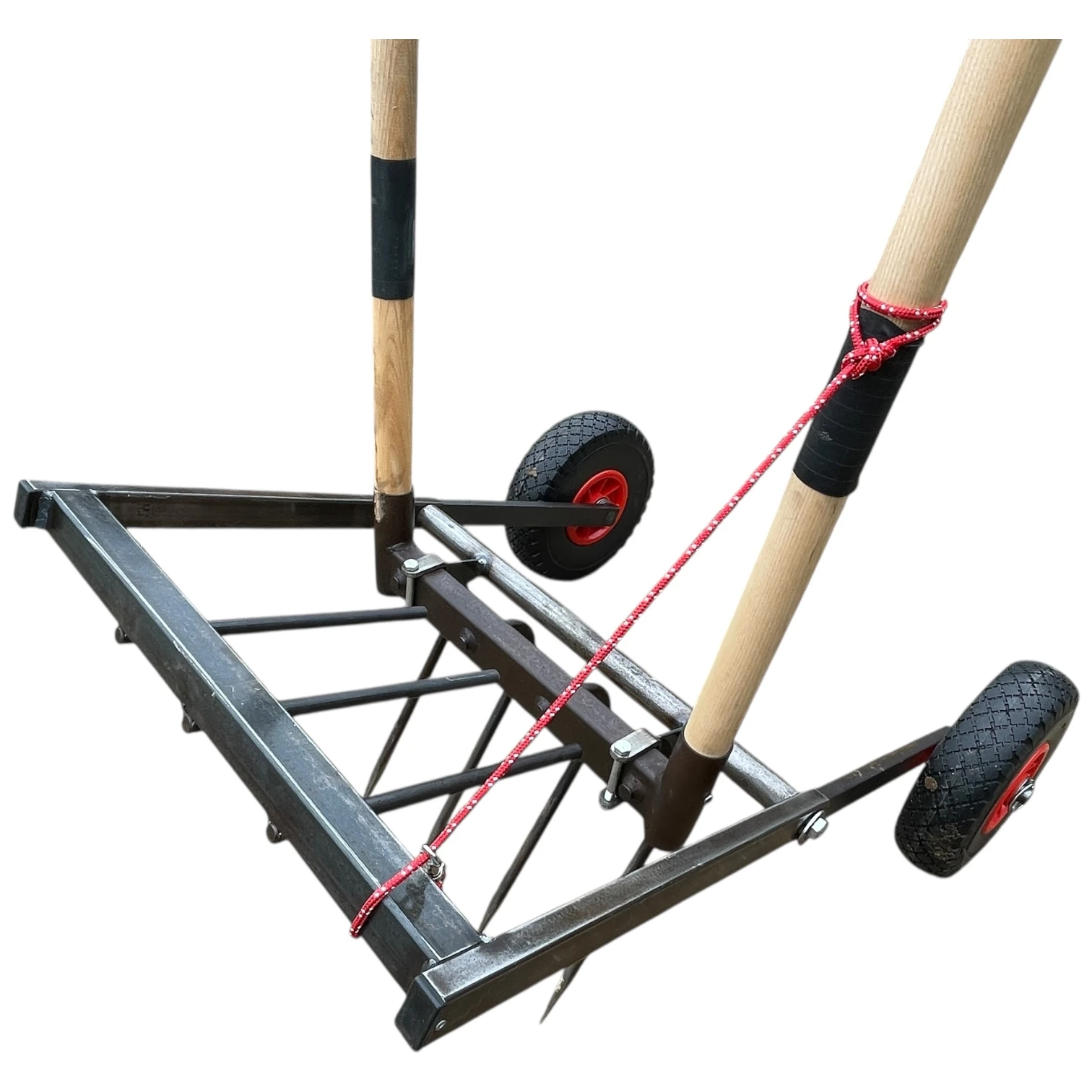
In November 2025, PLaisible® introduced a 2-in-1 tool: a classic broadfork fitted with a detachable clod breaker. You can use the broadfork on its own or attach the counter-tine crumbler whenever you need it.
The clod breaker function: a new milestone for the broadfork’s 50th anniversary
In 2010, a Russian company invented counter-tines designed specifically to break up clods. They filed a patent on October 18, 2010, to protect this new working mechanism. Using a scissor-like motion, the main tines lift the soil and press it up against horizontal counter-tines. This shearing action crumbles compacted clumps of earth as you pull back.
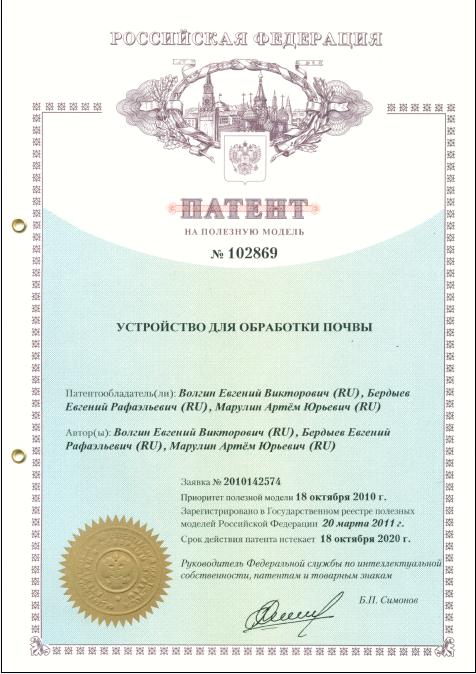
Below is the original Russian patent (No. 102869) filed on October 18, 2010, for this soil cultivation device.
Around the same time, still in Russia, another company developed a different pivoting broadfork design. Their new patent placed the counter-tines directly facing the main tines, unlike the first Russian model where the attachment sat on the pivot axis of the main tines. The result was a cleaner shearing action, with no risk of clods slipping through unbroken.
The pivoting broadfork arrives in France in winter 2014/2015
Always looking for greater efficiency to boost yields on a small acreage, growers tested a pivoting broadfork at the Ferme du Bec Hellouin in Normandy to crumble soil on specific growing beds.
Out of those trials came La Campagnole® in the summer of 2015, when Vincent Legris of La Fabriculture® began manufacturing and selling this French adaptation inspired by the Russian tools.
The latest evolution: La PLaisible and its detachable counter-tine crumbler
In Brittany, the makers of the La PLaisible broadfork took this concept a step further by designing a clod breaker that mounts directly onto their traditional broadfork.
The real breakthrough is modularity: the counter-tine crumbler is fully detachable. The same broadfork can be used solo for deep soil aeration, or fitted with its counter-tines to crumble clods and prep seedbeds before sowing and transplanting.
Several technical and ergonomic improvements were also built into the design:
- A counterweight system to prevent the front bar from sinking into the soil.
- A double foot bar to make driving the tines into the ground easier using your body weight.
- A detachable mechanism compatible with all non-arched La PLaisible broadforks (4 to 7 tines) manufactured since 2019.
- Reversible wheels so you can adjust your working direction and avoid rolling over freshly prepared soil.
This evolution keeps all the benefits of a classic broadfork while adding an effective clod-breaking function when needed.
Discover the innovations behind the La PLaisible broadfork and its detachable counter-tine crumbler.
Review & observations on wheeled broadforks with a clod breaker
Is it really an upgraded broadfork?
The movement is similar to using a classic broadfork: drive the tines into the soil, then rock the handles back. However, it lifts the soil higher to crush clods against the horizontal counter-tines.
- The counter-tine crumbler breaks down the lifted soil effectively, making seedbed preparation much faster.
- On the other hand, in soils with very distinct layers (horizons), it can mix soil strata that behave differently.
- Another potential drawback is bringing dormant weed seeds up to the surface, which can increase weeding work later on.
- That said, you get a ready-to-sow seedbed quickly without having to make a second pass with a cultivator or fork to break up clods. A quick pass with a wide bed rake is all it takes, which is a real time-saver.
I’d love to hear your thoughts in the comments. What is your experience with a wheeled broadfork with clod breaker, sometimes called an “upgraded broadfork”?